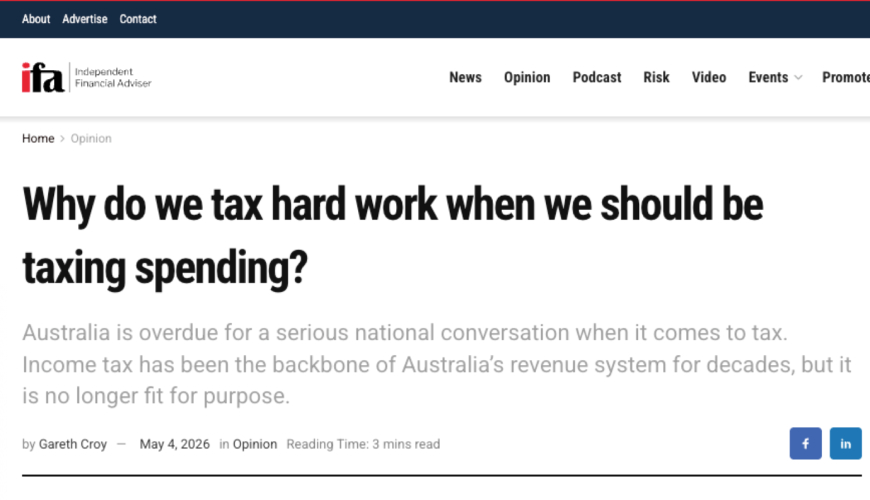




Australia is overdue for a serious national conversation when it comes to tax. Income tax has been the backbone of Australia’s revenue system for decades, but it is no longer fit for purpose.
Meaningful tax reform is generally treated as politically radioactive and no party wants to rattle the cage. But as the economy changes, the logic behind taxing wages as the primary source of government funding is increasingly being questioned, and the reality is that Australia’s tax system is increasingly misaligned with how the modern economy works.
%20(14).png)
If we are serious about long-term economic growth, productivity and fairness then one idea that deserves far more attention is taxing what we spend rather than what we earn with the abolition of income tax and the introduction of a broader consumption tax.
Personal income tax provides nearly half of Canberra’s revenue.
The more we work and earn, the more we are taxed. Taxing income effectively taxes effort. While progressive taxation has an important role, relying too heavily on income tax can discourage productivity and entrepreneurship.
A consumption-based system allows people to keep more of what they earn. Those who spend more contribute more to government revenue, while those who save or invest are not penalised.
For everyday Australians, this could mean bigger take-home pay packets. Instead of seeing a large portion of wages disappear before they reach your bank account, people would keep more of their earnings and decide how to spend or save it.
It would increase the purchasing power of a worker on $90,000 because they would have more money when they got paid. Buying power has been shrinking by more than $2700 a year since 2020, with predictions by the Reserve Bank this will only worsen as inflation rises.
It is also easier to track spending than monitor every form of income.
Countries such as New Zealand and Singapore have managed to do this successfully with tax systems that place greater emphasis on broad-based goods and services taxes.
Australia’s GST is relatively low and has numerous exemptions with income tax continuing to do the heavy lifting. This is going to become much harder to sustain.
A broader consumption tax spreads that burden more widely because everyone who participates in the economy contributes through their spending, including retirees and international students. Lower income households could be protected through targeted payments and increased support.
Australians deserve a tax system that rewards work, supports investment and remains sustainable for the next generation.
It is a conversation worth having, the question is, are we brave enough?
---
This article was published in the Independent Financial Adviser on Monday 04/05/2026